
高阶函数 reduce()讲解
更新: 9/4/2025字数: 0 字 时长: 0 分钟
一、介绍
首先 MDN 上 是这样描述 reduce 方法的:
reduce() 方法对数组中的每个元素按序执行一个由您提供的 reducer 函数,每一次运行 reducer 会将先前元素的计算结果作为参数传入,最后将其结果汇总为单个返回值。
说白了就是会将上一次的运行结果当做下一轮计算的初始值;
语法如下:
箭头函数写法;
reduce((previousValue, currentValue, currentIndex, array) => {
  /* … */
});
reduce((previousValue, currentValue, currentIndex, array) => {
  /* … */
}, initialValue);

回调函数洗发;
reduce(callbackFn);
reduce(callbackFn, initialValue);回调函数中有四个参数,回调的外面还有一个参数(initialValue给定就算的初始值);参数截图如下: 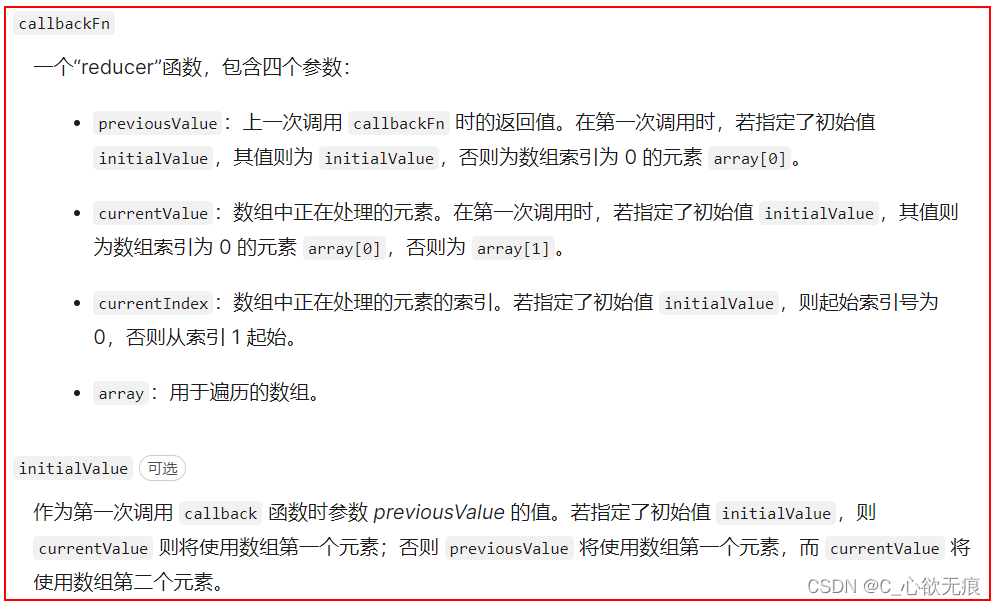
二、Array.reduce()的使用
看一下下面的代码:
const arr = [1, 2, 3];
const initValue = 10;
function reducer(previousValue, currentValue, currentIndex, arrryTarget) {
  return preValue + currentValue;
}
arr.reduce(reducer, initValue); // res === 16reduce 会遍历 arr 数组,数组有多少个,reducer 就会执行多少次。下面是执行流程:
| reducer 执行 | previousValue | currentValue | currentIndex | return |
|---|---|---|---|---|
| 第一次执行 | 10 | 1 | 0 | 11 |
| 第二次执行 | 11 | 2 | 1 | 13 |
| 第三次执行 | 13 | 3 | 2 | 16 |
这个过程用过 reduce 的应该都知道,MDN 上原话是这样的:
第一次执行回调函数时,不存在“上一次的计算结果”。如果需要回调函数从数组索引为 0 的元素开始执行,则需要传递初始值。否则,数组索引为 0 的元素将被作为初始值 initialValue,迭代器将从第二个元素开始执行(索引为 1 而不是 0)
也就是第一次执行 reducer 函数时,不存在“上一次的计算结果”。这里传递了初始值,因此 reducer 函数才从数组索引为 0 的元素开始执行,也就是
arr.length等于reducer执行次数。
但如果不传递初始值呢?我们改动一下代码:
const arr = [1, 2, 3];
const initValue = 10;
function reducer(previousValue, currentValue, currentIndex, arrryTarget) {
  return preValue + currentValue;
}
arr.reduce(reducer, initValue); // res === 16
arr.reduce(reducer); // res === 6| reducer 执行 | previousValue | currentValue | currentIndex | return |
|---|---|---|---|---|
| 第一次执行 | 1 | 2 | 1 | 3 |
| 第二次执行 | 3 | 3 | 2 | 6 |
因为没有传递初始值,因此 reducer 函数从数组索引为 1 的元素开始执行,首次执行的时候 arr[0] 被作为了 previousValue ,currentValue 就是 arr[1]。
三,reduce()的使用场景
下面是一些 reduce 方法的使用场景。
1,累加数组所有的值,累加可以,那么 加减乘除 中其他三个的原理是一样的不在多说;
let sum = [0, 1, 2, 3].reduce(function (previousValue, currentValue) {
  return previousValue + currentValue;
}, 0);
// sum is 62,累加对象数组里的值
要累加对象数组中包含的值,必须要提供 initialValue,以便各个 item 正确通过你的函数;
let initialValue = 0;
let sum = [{ x: 1 }, { x: 2 }, { x: 3 }].reduce(function (previousValue, currentValue) {
  return previousValue + currentValue.x;
}, initialValue);

console.log(sum); // logs 63,将二维数组转化为一维
第一种:
let flattened = [[0, 1], [2, 3], [4, 5]].reduce(
  function(previousValue, currentValue) {
    return previousValue.concat(currentValue)
  },
  []
)
// flattened is [0, 1, 2, 3, 4, 5]

第二种:
let flattened = [[1,2], [3, 4]].reduce((arrA, arrB) => [...arrA, ...arrB])那是不是封装一下就可以把多维数组组转为一维数组了?
function flaten(arr) {
  if (!Array.isArray(arr)) {
    return arr;
  }
  return arr.reduce((arrA, arrB) => {
    if (!Array.isArray(arrB)) {
      return [...arrA, arrB];
    }
    return flaten([...arrA, ...arrB]);
  }, []);
}
let flaten2 = flaten([1, 2, [3, 4], [6, [7, 8]]]);
console.log(flaten2);
[1, 2, 3, 4, 6, 7, 8];4,计算数组中每个元素出现的次数
此方法也需要提供初始值:{},用来给这个空对象添加属性,最后返回处理过的对象;
let names = ["Alice", "Bob", "Tiff", "Bruce", "Alice"];

let countedNames = names.reduce(function (allNames, name) {
  if (name in allNames) {
    allNames[name]++;
  } else {
    allNames[name] = 1;
  }
  return allNames;
}, {});
// countedNames is:
// { 'Alice': 2, 'Bob': 1, 'Tiff': 1, 'Bruce': 1 }5,按属性对 object 分类
注意:也要传初始值;
let people = [
  { name: "Alice", age: 21 },
  { name: "Max", age: 20 },
  { name: "Jane", age: 20 }
];

function groupBy(objectArray, property) {
  return objectArray.reduce(function (acc, obj) {
    let key = obj[property];
    if (!acc[key]) {
      acc[key] = [];
    }
    acc[key].push(obj);
    return acc;
  }, {});
}

let groupedPeople = groupBy(people, "age");
// groupedPeople is:
// {
//   20: [
//     { name: 'Max', age: 20 },
//     { name: 'Jane', age: 20 }
//   ],
//   21: [{ name: 'Alice', age: 21 }]
// }6,数组去重
1,第一种使用 reduce 方法,利用数组的 indexOf 方法来筛选;
let myArray = ["a", "b", "a", "b", "c", "e", "e", "c", "d", "d", "d", "d"];
let myArrayWithNoDuplicates = myArray.reduce(function (previousValue, currentValue) {
  if (previousValue.indexOf(currentValue) === -1) {
    previousValue.push(currentValue);
  }
  return previousValue;
}, []);

console.log(myArrayWithNoDuplicates);2,第二种方式使用 new Set集合(无序不重复);
// 另一种方式
let myArray2 = ["a", "b", "a", "b", "c", "e", "e", "c", "d", "d", "d", "d"];
let arrayWithNoDuplicates = Array.from(new Set(myArray2));
console.log(arrayWithNoDuplicates);7,使用 .reduce() 替换 .filter().map()
使用 Array.filter() 和 Array.map() 会遍历数组两次,而使用具有相同效果的 Array.reduce() 只需要遍历一次,这样做更加高效。
const numbers = [-5, 6, 2, 0];

const doubledPositiveNumbers = numbers.reduce((previousValue, currentValue) => {
  if (currentValue > 0) {
    const doubled = currentValue * 2;
    previousValue.push(doubled);
  }
  return previousValue;
}, []);

console.log(doubledPositiveNumbers); // [12, 4]End
【参考文章】:
1,码云笔记的博客:https://blog.csdn.net/qq_41221596/article/details/129227617?spm=1001.2014.3001.5502
2,MDN-reduce:https://developer.mozilla.org/zh-CN/docs/Web/JavaScript/Reference/Global_Objects/Array/reduce